
The skinalchemy Method™
Understand what changed before deciding what to treat.
Developed by Sonia Vilos, NP
You bring the observation.
We bring the anatomy.
The plan is built where the two meet. These are reasoning functions, not a rigid protocol: several can happen together, and reassessment can return the plan to an earlier one.
Observation
What has changed for the patient?
PreventsReplacing the patient’s concern with a treatment menu.
Read
What do structure and support, movement, tissue and collagen, and skin show us?
PreventsTreating one visible area in isolation.
Contributor
What is plausibly driving or amplifying the concern?
PreventsConfusing location with mechanism.
Has this recommendation earned a place in the plan?
PreventsTreating because something is technically possible.
Job
What exactly is this intervention being asked to change?
PreventsUsing a treatment outside the problem its mechanism can address.
Sequence
Why this treatment, at this time, in this order?
PreventsTreatment stacking and automatic packages.
Treat + time
Allow the intervention and the biological response to declare useful information.
PreventsRushing the second decision before the first one has taught us anything.
Reassess
What did the response teach us, and does the next step still belong?
PreventsAutomatic maintenance and repetition.
Reassessment can return the plan to an earlier reasoning function



A heavier jawline can start in four places.
The place where a change is visible is not always where the decision begins. One concern can have several contributors, and assessment identifies which are plausibly yours.
Deep support
We look at
Jaw width, chin projection and the underlying bony frame.
What that means
If support is driving the change, adding surface volume may make the lower face feel heavier.
Collagen
We look at
Tissue thickness, firmness, laxity and how the lower face holds tension.
What that means
The priority may be rebuilding tissue quality before changing contour.
Volume
We look at
Where fullness sits, how it moves and whether it is structural or acquired.
What that means
Treatment may mean reducing, redistributing or leaving volume alone. Not automatically adding more.
Muscle pull
We look at
The downward pull of the platysma and the balance of the chewing muscles.
What that means
Relaxing the right pull can sharpen the jaw without treating the jawline itself.
From the outside these look the same. Often it's two of them at once.
This shows why one concern can have more than one contributor. It does not replace an assessment.
Has this recommendation earned a place in the plan?
The standard the practice applies to its own recommendation before an intervention enters the plan. It is not a score, a beauty scale or an eligibility test, and it is not something a patient passes or fails.
The patient is not being judged. Our recommendation is.
Do we understand the concern well enough to act?
Is there a plausible contributor?
Does the proposed treatment actually address that contributor?
Is the expected improvement meaningful enough to justify intervention?
Is the timing and sequence right?
Does the decision protect proportion, expression, identity and future options?
What the threshold can decide
- Treat now
- Stage treatment
- Treat another layer first
- Correct previous treatment first
- Wait
- Preserve
- Refer
- Reassess
- Recommend no treatment at this time
The Treatment Threshold is not designed to make plans smaller. It is designed to make every part of the plan more defensible.
Some of the most important work here is the treatment that doesn't happen.
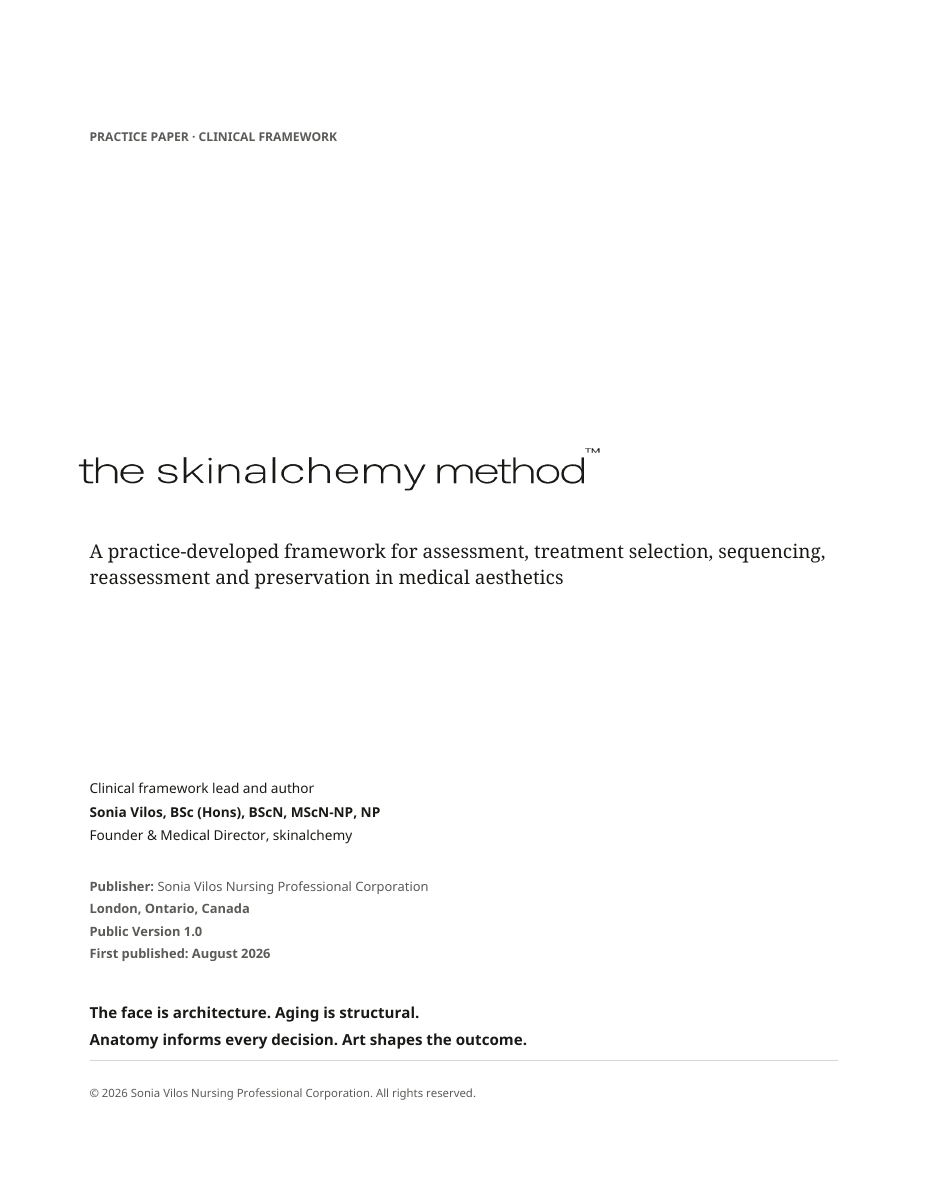
The full Method, Version 1.0.
The complete framework, first published in August 2026 and intended to function as a practice standard rather than one clinician's personal style.
Sonia Vilos, BSc (Hons), BScN, MScN-NP, NP
Publication details and citation

A question is enough to begin.
Arrive with a concern or a treatment in mind. We can begin with either.
Start with a consultation